Lewisburg, West Virginia bills itself as the Coolest Small Town in America, and it has the paperwork to prove it. Back in 2011, Budget Travel magazine ran a reader poll and Lewisburg ran away with it, beating Astoria, Oregon by more than 11,000 votes.
Here is the part that made me laugh. Budget Travel handed out the same title every year, to a different town each time,
for about a decade. Pile on all the towns that just slap the label on themselves with no contest at all, and you wind up with a whole lot of coolest small towns in America. Fayetteville, a nearby small town up by the New River Gorge, claims it too. So depending on which welcome sign you believe, you can cross one corner of West Virginia and pass through two coolest small towns in America before supper. Lewisburg, to its credit, is one of the few that can still show you the trophy.
We would love to tell you we did Lewisburg justice. We did not. We rolled into the State Fairgrounds with the Greenbrier bunker and New River Gorge National Park already written on the calendar, and we treated the town itself like a very pretty parking spot. So this is the post where we make our amends and hand you the list we wish we had worked through ourselves. Maybe on my next time through!
What we actually managed
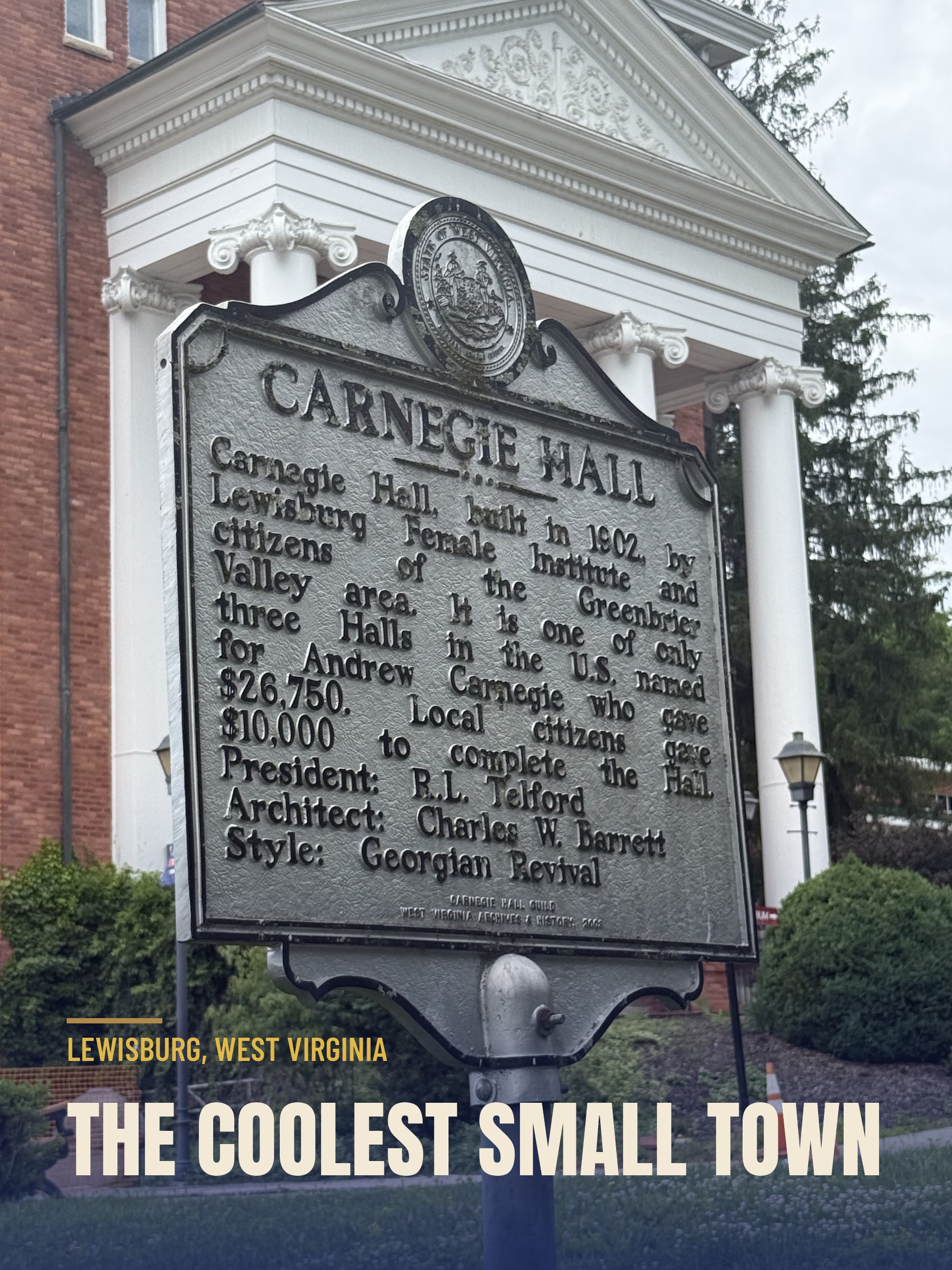
We drove through the historic downtown more than once, and it is every bit as charming as the brochures promise: brick storefronts, and walkable blocks. We pulled up to Carnegie Hall and grabbed photos from the sidewalk, which is worth doing even if you never step inside. More on why that building matters in a minute.
For dinner one night we hit Old Red Mill, and this was the one that stuck with us. Great atmosphere, a live band, the whole room in a good mood. I had my eye on the brisket until I asked about it and our server told me it did not have much fat on it. Anybody who has spent time around a smoker knows where that goes. Fat is flavor. No fat on brisket usually means dry and tough. I steered to the wings instead and was glad I did. They were excellent. If anyone goes and has the brisket, let me know how it is.
Another night we tried Hill & Holler, a solid pizza and calzone spot. I ordered a calzone, which made it the second place in a row to hand me a calzone with no ricotta in it. A calzone with no ricotta is just a poorly shaped stromboli.
We also made it out to Greenbrier Valley Brewing in nearby Maxwelton, which turns out to be the largest production brewery in the state. The beers are all named for Appalachian legends and tall tales, Devil Anse, Mothman, Wild Trail, and there is a kitchen on site called The Hangar slinging a Puerto Rican and Appalachian mashup. I had a Levicy Hazy IPA and a Devils Anse IPA. I would classify them as average for their style. The atmosphere was cool and it appeared they often had live entertainment.
The ones that got away
And now, the list. Pour one out for everything we did not get to.
Carnegie Hall. We saw the outside. We did not see a show, and that was a mistake. This is one of only four Carnegie
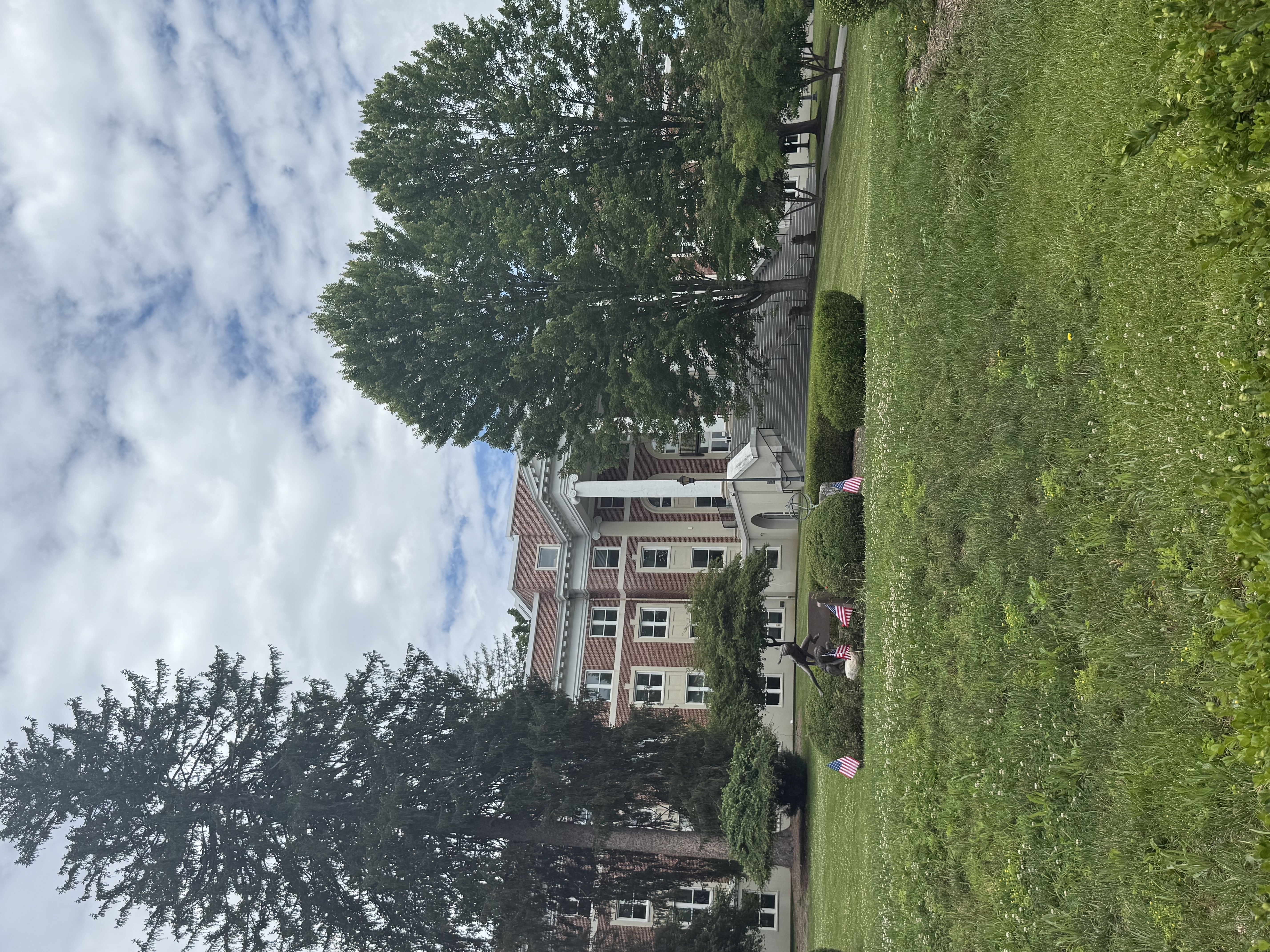
Halls in the world, built in 1902 with a check from Andrew Carnegie himself, and it has hosted the likes of Taj Mahal, Gillian Welch, and Ralph Stanley on a stage in a town of about 3,500 people. There are rotating galleries, public tours, and free outdoor concerts in summer. Next time we are checking the events calendar before we check the map.
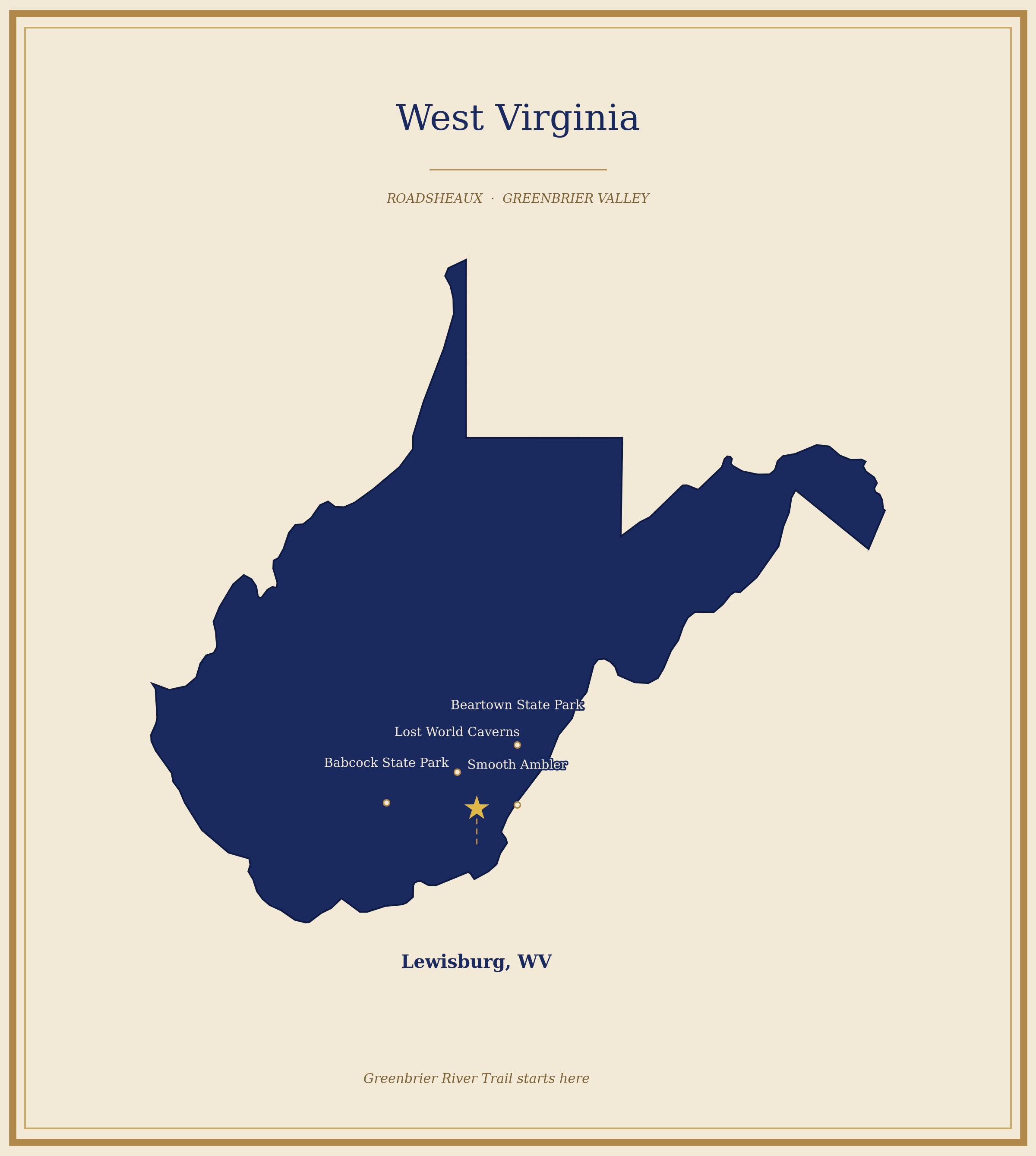
Lost World Caverns. We passed the signs roughly forty times and never once turned in, which is a shame, because it is exactly our kind of detour. Given our already aggressive agenda, we just didn't have time. It is a self-guided cave a couple of miles from town, a half-mile loop through a 1,000-foot room that takes about 45 minutes at a wandering pace. It holds a steady 52 degrees year round, so a light jacket would be smart. The headliner is a 28-foot stalagmite called the War Club, made famous by a fellow who once sat on top of it for nearly 16 days to land in the Guinness book, which might be the most West Virginia sentence we have ever written.
The Greenbrier River Trail. This one stings the most. The southern end of West Virginia's longest rail-trail sits right at Caldwell, just outside town, 78 miles of old railroad grade following the river on a gentle 1 percent grade. You can rent bikes or e-bikes in Lewisburg, drive to the trailhead, and ride out as far as your legs feel like before turning around.
Smooth Ambler. The distillery sits literally next door to the brewery we did visit, and we still whiffed on it, because it closes at five and we were out chasing other adventures every single day. It is a grain-to-glass bourbon and whiskey operation with a tasting room and tours. Many of the local restaurants / bars have their products if you don't have time to get to the distillery itself.
The scenic drives. Every road around here seems to feed into a named byway. The Cranberry Corridor loops up toward Summersville and the working Glade Creek Grist Mill. The Seneca Skyway is a 300-mile circle through the high country. The Midland Trail, the oldest scenic byway in the state, runs right through town. These are real road trips in their own right, the kind you give a full day or three. Given the fact that we spent one of our three days doing the Highlands Scenic Trail; we figured it best to leave the others for another time.
The state parks. This is the one that really got us, because the brown signs are everywhere and we visited exactly none of them. There are something like six to eight state parks and forests within an hour of Lewisburg. Two we are circling for next time: Babcock State Park, home of the Glade Creek Grist Mill, which is the most photographed spot in the whole state and the kind of postcard cameras were built for, and Beartown State Park, a strange and wonderful little place atop Droop Mountain where a half-mile boardwalk loop, about 20 to 30 minutes to walk and get back to the car, threads through giant boulders and deep crevices they call the town of rocks.
Lewisburg handed us a long list of reasons to come back,.