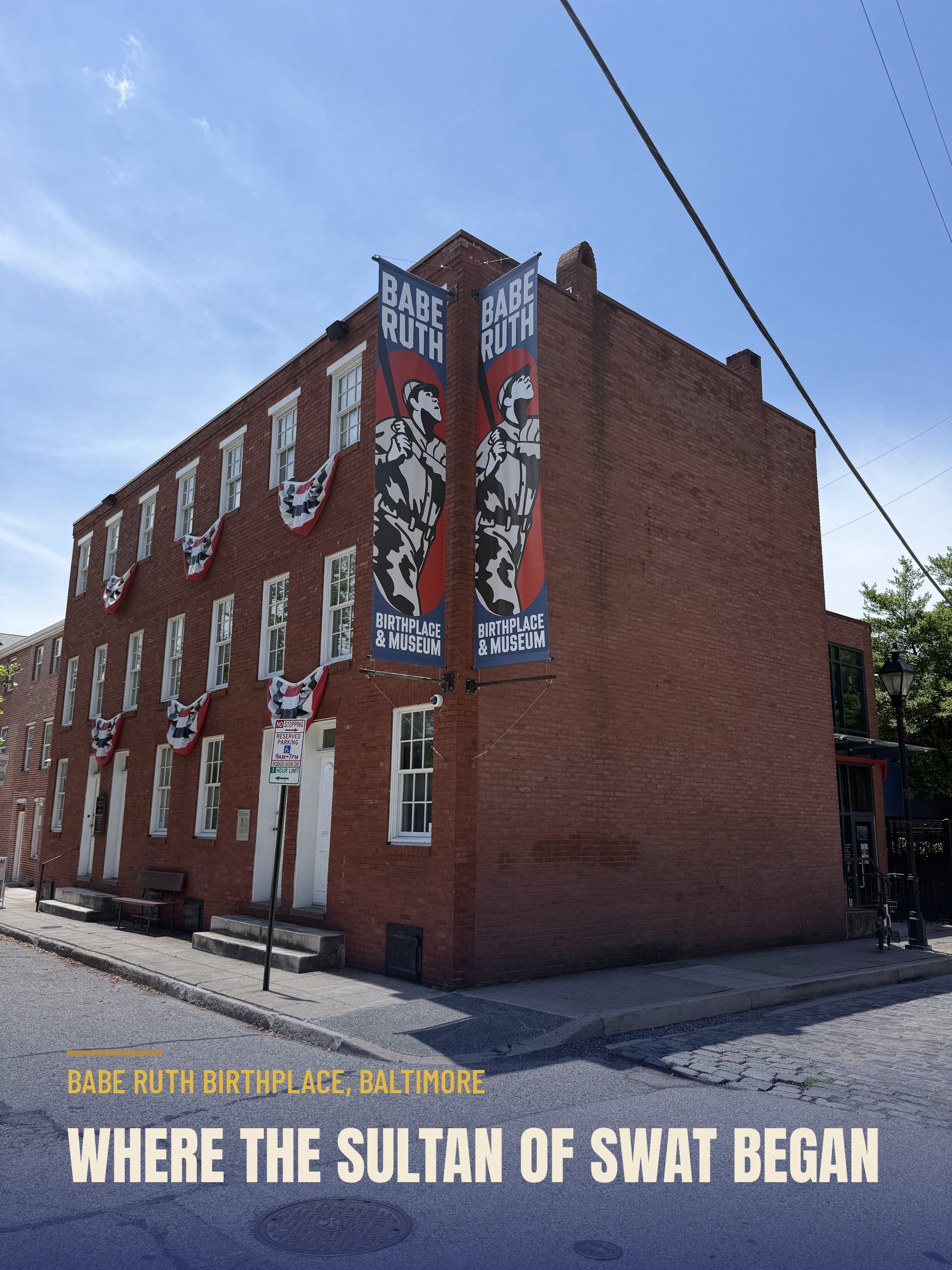
We started our Baltimore day a few blocks off the harbor at 216 Emory Street, a skinny brick rowhouse on a quiet side street where George Herman Ruth came into the world back in 1895. You would walk right past it if the painted sign and the plaque out front did not stop you. It is hard to square the little upstairs bedroom where he was born with the size of the man he became, and that is a big part of the charm of the place. The Babe started out here in a tight Baltimore rowhouse, a long way from the ballparks and the legend that came later.
Inside, the house opens up into a full museum, and we walked out knowing a whole lot more about the Babe than we walked in with. We knew the home run records. We had no idea how much of the rest of his story we had been missing.
Start with his start in the game. Before he was the Sultan of Swat, Ruth was one of the best left-handed pitchers in baseball, and his first few years with the Boston Red Sox they barely let him swing a bat because they needed his arm on the mound. We stood there and did the math on that one. Three seasons of a young Babe Ruth pitching instead of hitting full time, and you have to wonder how many home runs got left on the table before anyone figured out what they were sitting on.
His first home run as a professional came right here in the Carolinas, which we did not see coming. In the spring of 1914, a nineteen-year-old Ruth was in Fayetteville, North Carolina for spring training with the minor-league Baltimore Orioles when he launched a long one in an exhibition game. Fayetteville is also where his older teammates started ribbing him as the owner's new babe, and the nickname stuck for the rest of his life. There is a catch worth knowing. Baseball fans up in Toronto stake their own claim to his first home run, because that September Ruth hit one at Hanlan's Point for the Providence Grays in a regular-season game that counted in the standings. The Fayetteville blast came in a spring exhibition, so the distinction is that Fayetteville gave him his first home run as a pro and Toronto gave him the first one in a game that actually mattered.
Then there is the national anthem. We had always figured the anthem and baseball just came as a pair, but the tradition traces back to a game Ruth pitched. During Game 1 of the 1918 World Series, with the country deep in World War I, a band struck up The Star-Spangled Banner during the seventh-inning stretch while Ruth was on the mound for Boston. The crowd came alive for it, the idea caught on, and over the following years it moved up to before the first pitch where we hear it today. The song would not even be named the official national anthem until 1931.
Another piece that caught our attention was his Presidential Medal of Freedom. President Trump awarded it to Ruth in 2018, seventy years after the Babe died, and his family handed the actual medal over to the museum, so it sits right there in Baltimore now for anyone to come see. He earned it not just for his greatness on the field but for the life he led off it, from visiting children in hospitals and orphanages to supporting more than a hundred charities and raising money for the war effort. We also did not know that Ruth was something of a medical pioneer at the very end of his life. When he was dying of cancer in 1947, he became one of the first people anywhere to take an experimental chemotherapy drug, paired with radiation, a combination that helped lay the groundwork for how a lot of cancers are still treated today. He knew the treatment was a long shot and took it anyway, in part so his doctors could learn something from it.
For a couple of baseball fans, standing in the room where he was born and reading all of that was worth getting an early start before heading over to the inner harbor.
Gallery
Check out our other posts about this stop:
- Washington, DC: The Bucket List You Can't Finish in a Week
- Cherry Hill Park: A Capital Basecamp on a Family Farm
- Goosebumps in the Gallery: A Day with Two Branches of Government
- Big Marble and a Quiet Hill: The Mall Monuments and Arlington
- The C&O Canal and the Streets of Georgetown
- Crab Cakes and Meatballs: A Day Around Baltimore's Harbor
- A Long Porch Above a Wide River: George Washington's Mount Vernon
- Harpers Ferry: Rivers, Rifles, and Rebellion